

(BOISE, IDAHO) Aviation Specialties Unlimited, Inc. (ASU), a trusted provider modifying aircraft for civil and military night vision operations for more than 25 years, received notification from EASA that ASU has obtained STCs for the Bell 212, 412, AB212, AB412, and 412EP under a single EASA STC 10078190. The original STC from the FAA is SR01634SE.
Because of ASU’s proven history with the FAA and EASA, ASU’s Company Test Team can save customers time and money when navigating STC requirements for aircraft modifications for both helicopters and fixed-wing aircraft.
“Our test team collaborated closely with the FAA and EASA for years,” said ASU Vice President of Business Development and experienced instructor pilot Chad St. Francis. “Alex and Kip’s experience allowed ASU to streamline the approval process, saving our customers from critical downtime and delays.”
ASU’s Chief Pilot Alexander Emmel, performing duties as an FAA and EASA Cat II Test Pilot, and Vice President of Aircraft Services Kip McDermott are both working on separate DER designations. They worked hand-in-hand with EASA to ensure everything was properly tested, documented, and certified to obtain the essential STC.
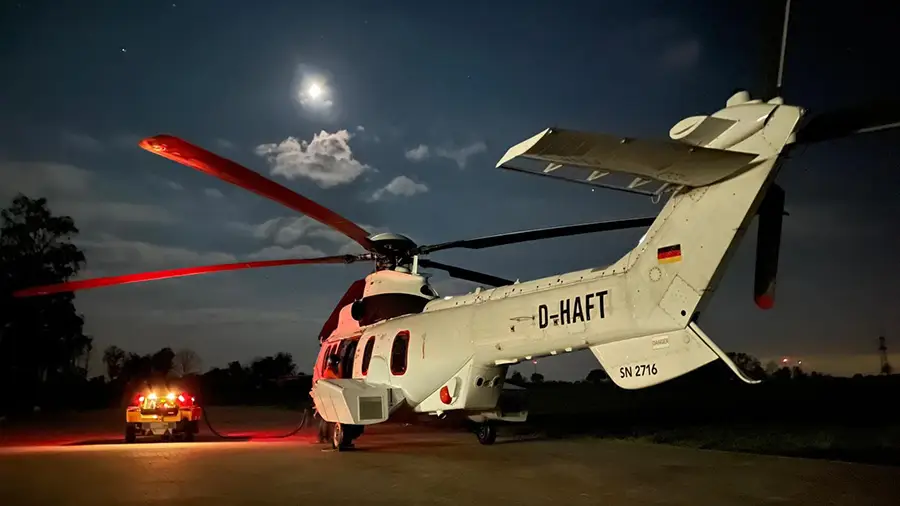
The STC for these aircraft was critical for ASU’s partner, Global Helicopter Service, to equip their fleet for nighttime peacekeeping missions worldwide. Last year, ASU also obtained a similar STC on the H225 for United Nations missions in Africa.
“Saving our customers time and money is vital to getting them back to their peacekeeping missions,” said Emmel. “ASU’s mission is to help helicopter operators fly safely using NVGs. We can think of no better way to do this than to modify the aircraft lighting for night vision operations, assure pilots and crew are trained, and enable them to utilize the game-changing technology that NVGs offer.”
Global Helicopter Service is an EASA approved helicopter company based in Kirchanschörng, Germany. GHS offers numerous services utilizing a flexible fleet of helicopters that includes the well known Sikorsky S76C++, the robust Bell 412 and the sophisticated Airbus H225.
“GHS is honoured to partner with ASU as a distributor for Europe providing required inspections and certifications as well as related services of advanced night vision technology products,” said Dominik Goldfuss, CEO of GHS.
ASU currently holds more than 60 night vision STCs from the FAA, EASA, and other aviation administrations. Join ASU at Heli-Expo booth 5104 to discuss your STC requirements, aircraft modification needs, and night vision programs. Also, visit Global Helicopter Service GmbH to learn about their fleet and global operations at booth 6123.